Direct Selling: The Strategic Sales Channel of Choice in Today's Digital World
Executive Summary
Modern commerce stands at a critical juncture. Traditional high street retail continues to suffer from structural decline driven by rigid overheads, dropping footfall, and evolving consumer habits. Simultaneously, pure-play e-commerce faces severe margin compression due to rampant customer acquisition cost (CAC) inflation, pervasive ad fatigue, and strict privacy headwinds that limit third-party targeting. To maintain sustainable growth, brands must pioneer resilient customer acquisition models.
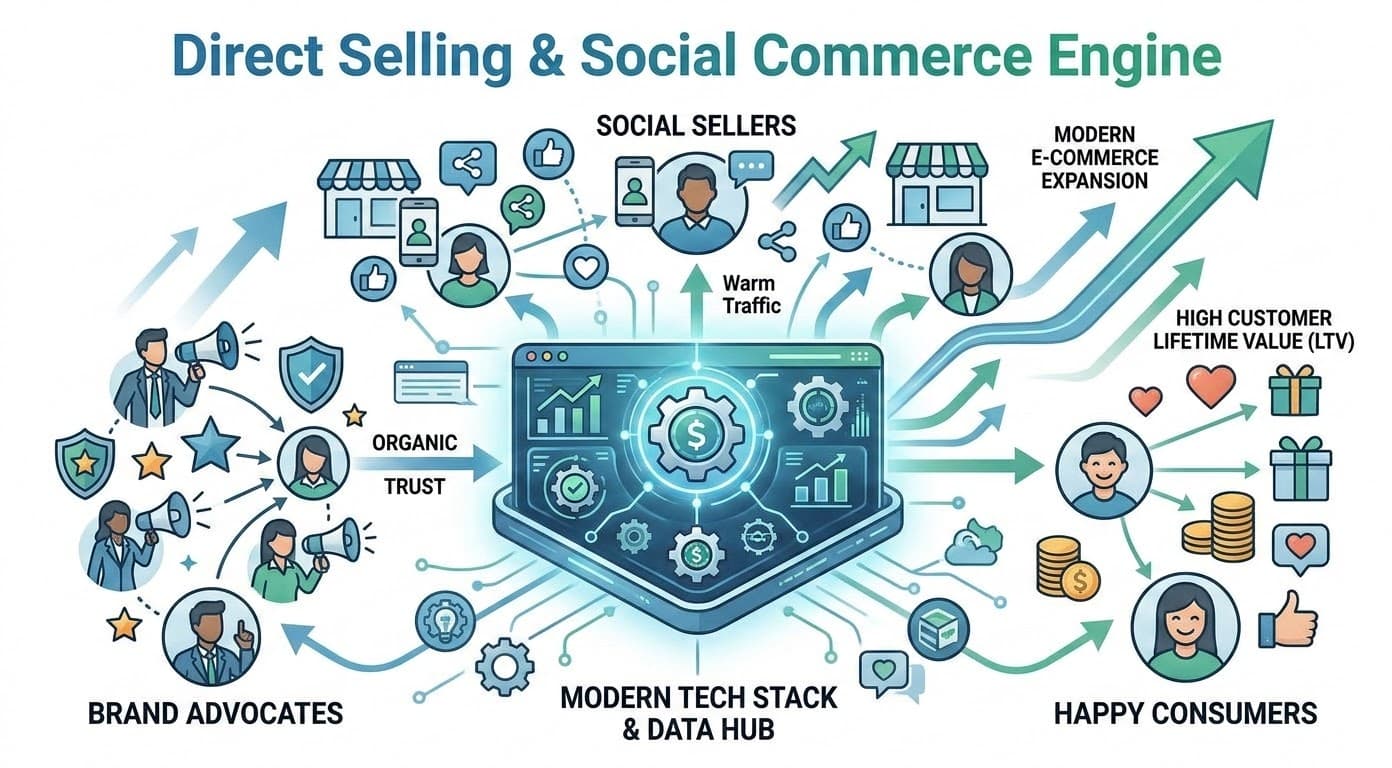
This document outlines how direct selling—modernized through social commerce, brand advocates, and decentralized seller networks—serves as a high-performing strategic channel. By combining organic peer-to-peer trust with performance-aligned compensation and direct first-party data ownership, direct selling offers a scalable solution to modern acquisition hurdles and drives long-term customer lifetime value (LTV).
Section 1: The Structural Decline of Traditional High Street Retail
The structural decline of traditional high street retail over the last two decades is driven by a combination of compounding macroeconomic pressures, structural financial burdens, and fundamental shifts in consumer expectations.
- The Footfall-to-Revenue Spiral: Physical retail relies heavily on predictable foot traffic to support impulse purchases and high fixed costs. As e-commerce expanded, general browsing shifted online, starving physical stores of the casual foot traffic needed to cover expensive leases.
- Asymmetric Cost Pressures (Business Rates & Rent): Traditional retailers faced a toxic combination of skyrocketing commercial rents and high business rates (property taxes), which remained rigid even as store revenues declined. Online-only competitors bypassed these physical real estate overheads entirely.
- The Shift Toward "Experiential" Spending: Consumer spending habits evolved. Modern consumers—particularly younger demographics—increasingly prioritize spending disposable income on lifestyle, travel, and digital services rather than accumulating traditional material goods or department store inventory.
- Inflexibility and Legacy Infrastructure: Many major high street casualties suffered from slow supply chains, massive central bureaucracies, and a late or clumsy pivot to digital operations. They were unable to compete with digital-native platforms that offered frictionless checkout, infinite digital shelf space, and rapid delivery.
Section 2: E-Commerce Congestion & Customer Acquisition Hurdles
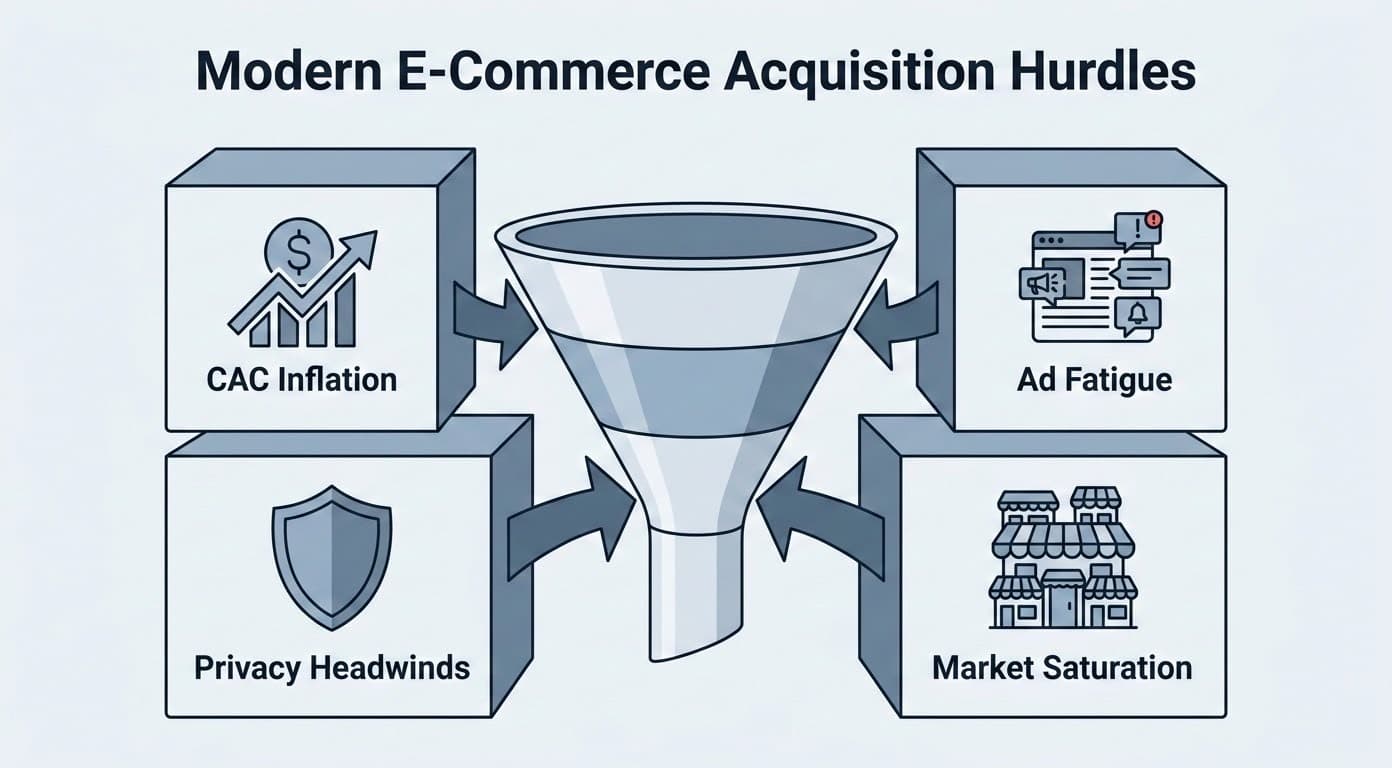
While e-commerce initially offered an escape from physical overheads, the modern digital landscape has become heavily saturated. Capturing consumer attention is now vastly more complex and costly due to key structural friction points.
- Pervasive Ad Fatigue and Digital Noise: Audiences face endless bombardments of marketing promotions across search channels, social platforms, and personal inboxes. This intense saturation dilutes message impact, creating immense friction for growing brands striving to capture meaningful attention.
- Escalating Acquisition Costs (CAC Inflation): Hyper-competitive bidding on major ad networks has driven customer acquisition expenses to historic highs. Consequently, relying strictly on direct-response paid media rapidly erodes operating margins.
- The Erosion of Paid Media Credibility: Years of invasive retargeting and polished corporate promotions have fostered widespread skepticism. Modern buyers increasingly discount traditional brand messaging in favor of validated peer experiences.
- Privacy Headwinds and Targeting Constraints: Heightened regulatory protections and mobile platform restrictions have dismantled traditional third-party tracking. Without granular consumer data, marketers face decreased attribution visibility and diminished audience precision.
- Market Saturation via Lower Barriers to Entry: While modern software makes establishing an online storefront simple, it fuels an influx of generic competitors. This hyper-fragmentation floods buyers with interchangeable alternatives, destroying baseline brand allegiance.
Section 3: Direct Selling as a Customer Acquisition & Traffic Driver
Direct selling—leveraging a network of brand advocates, social sellers, or micro-communities to recommend products directly to consumers and guide them to a centralized e-commerce platform—serves as an efficient engine for driving warm traffic and sustainable growth.
1. Combating "Ad Fatigue" Through Trusted Human Connection
Direct selling bypasses traditional advertising friction by leveraging genuine human-to-human recommendation. When an independent advocate champions a product within their personal sphere, it carries organic trust that paid ads cannot buy. This peer validation significantly boosts conversion intent when users reach the store.
2. Turning Sales Reps Into Performance-Driven Traffic Drivers
Rather than allocating capital to speculative upfront ad clicks, a direct selling model aligns acquisition costs directly with conversion performance. Sellers act as brand ambassadors who generate social proof, curate content, and direct warm traffic via referral links, shifting marketing expenditure into a variable cost structure.
3. Hyper-Targeted Niche Penetration
Direct sellers excel at localized community building. Rather than competing in broad digital ad auctions, sellers engage micro-segments of consumers with tailored recommendations, guiding them directly to specific product solutions.
4. Direct First-Party Data & LTV Ownership
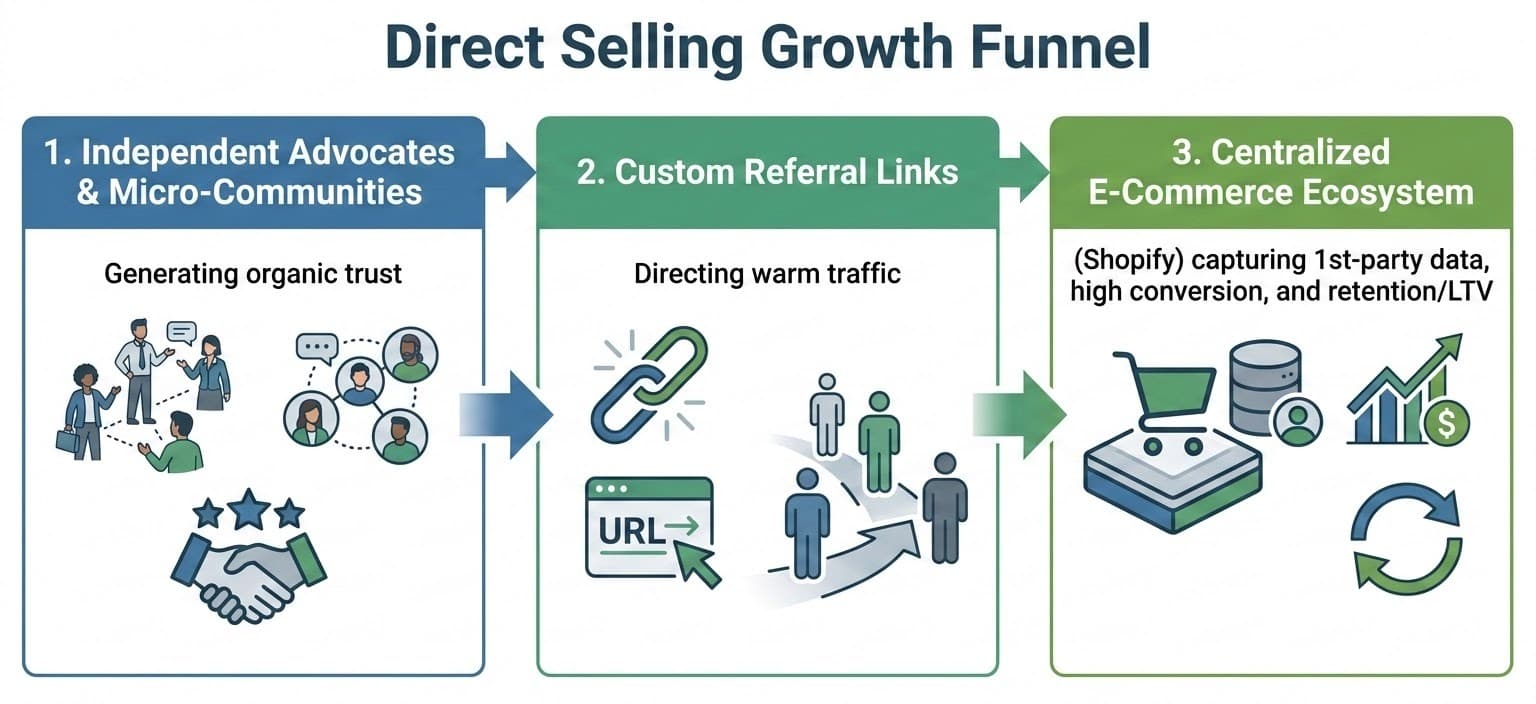
Unlike third-party marketplaces that restrict seller-customer interactions, direct selling funnels every customer directly into the brand's primary e-commerce ecosystem. Every visitor becomes a first-party asset, enabling retention campaigns, lifecycle marketing, and higher Lifetime Value (LTV).
Section 4: Comparative Ecosystem Analysis: Influencers, Affiliates, & Brand Ambassadors
While the terms "brand ambassador," "influencer," and "affiliate" are often used interchangeably in modern marketing, they represent distinct relationships, compensation models, and levels of brand loyalty. Understanding these differences is crucial when structuring a direct-selling or social-selling channel for an e-commerce brand.
The core differences lie in duration, depth of relationship, compensation, and audience alignment.
1. Influencers (The Reach Drivers)
Influencers are content creators who have built an audience around their personality, expertise, or aesthetic (e.g., beauty vloggers on TikTok or YouTube).
- Primary Objective: Brand awareness and top-of-funnel reach.
- The Relationship: Usually transactional, campaign-based, or short-term. You pay them a flat fee to create a specific number of posts or videos introducing your product to their audience.
- Audience Dynamic: Their followers look to them for trends and recommendations, but the connection can sometimes be broad or parasocial. Once the campaign ends, the relationship often pauses.
- Best For: Launching a new product line, creating immediate spikes in website traffic, and generating high-converting ad creative (UGC).
2. Affiliates (The Performance Drivers)
Affiliates are digital marketers, bloggers, coupon sites, or creators who promote products primarily to earn a commission on sales they generate.
- Primary Objective: Direct conversion and sales volume.
- The Relationship: Performance-driven and metrics-focused. They receive a unique tracking link or discount code, and they only get paid when a sale actually happens.
- Audience Dynamic: Affiliates may or may not have a personal brand or a loyal community. Many use search engine optimization (SEO), product round-up articles, or paid media arbitrage to drive traffic.
- Best For: Scalable, risk-free customer acquisition where you only pay out marketing dollars after securing revenue.
3. Brand Ambassadors (The Community Advocates)
Brand ambassadors are genuine, long-term partners who deeply align with your brand ethos and integrate your products into their daily lives.
- Primary Objective: Long-term brand loyalty, trust-building, and community advocacy.
- The Relationship: Long-term and collaborative. Ambassadors are treated like extended team members. They often receive continuous product seeding, exclusive access to upcoming launches, and a mix of retainers, free product, and commission.
- Audience Dynamic: Highly authentic and relational. Because they consistently use and advocate for the brand over months or years, their community views their recommendation as a lifestyle endorsement rather than a paid ad.
- Best For: Direct selling, social commerce models, and building an organic, highly engaged customer base that actively drives word-of-mouth traffic to your site.
Comparison at a Glance
Feature
Influencer
Affiliate
Brand Ambassador
Duration
Short-term / Campaign-based
Ongoing (as long as links perform)
Long-term (Months to Years)
Primary Pay
Flat fee per post/video
Commission % per sale
Mix (Free product, commission, retainers)
Brand Loyalty
Low to Moderate (may work with competitors next week)
Variable (focused on earning potential)
High (exclusively or passionately dedicated to the brand)
Focus
Reach & Views
Conversions & Revenue
Advocacy & Community Trust
Section 5: Strategic Recommendations & Conclusion
To successfully implement a direct/social selling channel alongside existing digital operations, brands should consider the following actionable steps:
- Integrate Modern Tech Stack: Seamlessly connect referral tracking, personalized storefronts, and automated payout management into your main e-commerce platform (e.g., Shopify).
- Empower Advocates with Turnkey Tools: Provide brand ambassadors with ready-to-share social assets, product education, and transparent real-time analytics to drive engagement.
- Align Performance Incentives: Structure tiered commission models and non-monetary rewards (e.g., early access, community status) to convert casual affiliates into dedicated long-term brand partners.
- Leverage First-Party Data for Retention: Capitalize on warm, seller-driven traffic by instantly capturing user data to build automated email lifecycle flows, maximizing long-term LTV.
In conclusion, while high street retail faces ongoing disruption and traditional digital ad channels suffer from margin erosion, direct selling provides a resilient, performance-aligned alternative. By harnessing trusted human connections and capturing direct customer relationships, direct selling stands out as the strategic channel of choice for modern commerce.
Ready to learn more?
Discover how our commission modelling and software can help you scale.
Book a Discovery Call